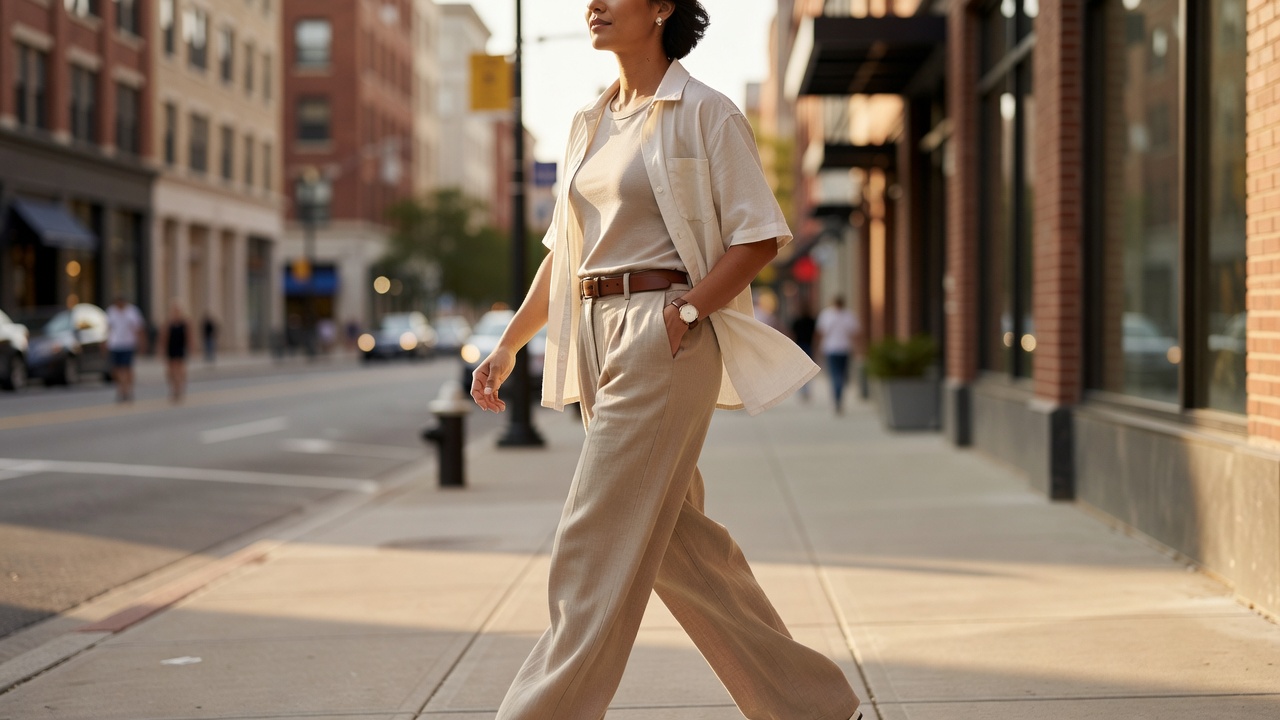
A screen outfit arrives with advantages your morning wardrobe does not: a chosen location, controlled lighting, a narrative and a camera angle. Copying every visible piece will not reproduce those conditions. A more useful approach is to identify the arrangement that caught your attention, then rebuild it around your actual day. This turns admiration into a styling tool rather than a shopping assignment.
Name the relationship, not the product
Try describing a reference without a designer, actor or film title. “Soft volume over a narrow base” is actionable. So is “one long colour line interrupted by a pale collar.” If the description depends entirely on a particular handbag, you may be responding to an object rather than an outfit. That is allowed, but it is a different problem to solve.
Annie Hall, Clueless and The Devil Wears Prada remain useful viewing prompts because each offers recognisable relationships between clothing and social setting. They are not universal instructions for dressing. Look beyond the most circulated image: notice layering, repeated shapes and how clothes behave when characters move. Your interpretation should remain distinct from any documented account of the costume design.
Run a no-purchase wardrobe test
Choose a single reference and write down three visible qualities. Perhaps the shape is roomy, the palette restrained and the footwear compact. Pull pieces you already own that could express those qualities. They do not need to match the originals. A cardigan may supply the softness of a jacket; a familiar flat shoe may preserve the visual balance of a heel without asking you to change how you walk.
Make the first version deliberately simple. Remove one accessory before adding another. Photograph the outfit at a comfortable distance, but also judge it without a camera. Can you reach a shelf? Does the waistband remain comfortable while seated? Can the pockets hold what you actually carry? A personal wardrobe needs to pass these tests, not merely look plausible in a mirror.
Let proportion do the work
Length is often more influential than price. A top ending at the hip makes a different division from a tucked shirt; a trouser hem resting on a shoe produces a different line from an exposed ankle. Neither is inherently correct. Adjust one variable at a time so you can see what changes. A temporary fold is enough to test an idea before committing to an alteration.
If tailoring is appropriate, discuss the garment’s construction with a qualified alterations professional. Changing a hem can be straightforward; changing a shoulder can be considerably more involved. Ask what is feasible before assuming every second-hand find can become an exact fit. Keep the original care label, inspect seams and closures, and consider the cost of repair alongside any purchase price.
Translate colour into a relationship
Film colour is mediated by lighting, grading and display settings. Chasing an exact shade from a screenshot can become frustrating. Instead, borrow a structure: warm neutrals with one darker anchor, a near-monochrome outfit with contrasting texture, or a quiet base with one saturated accent. These ideas work across different personal preferences and do not require matching a performer’s colouring.
Material changes the result. A cream cotton shirt and cream satin blouse can occupy a similar colour position while creating very different levels of reflection and formality. Lay possible combinations together in daylight. Then try them on; the body introduces folds, shadows and movement that a flat arrangement cannot show.
Make room for climate, access and routine
A cinematic coat is not a useful daily reference if it overheats you on public transport. A trailing hem may be unsuitable for wheels, stairs or wet pavements. Adapt fastenings, layers and footwear to your mobility and comfort requirements. These are design considerations, not compromises that make the result less stylish.
Repeat the outfit on an ordinary day before deciding whether it belongs in your rotation. Note what you adjusted without thinking: a sleeve pushed up, a bag moved across the body, a collar opened. Those gestures are valuable evidence. The best version may drift away from the source, and that is the point. A reference has become personal style when it supports your own habits instead of asking you to impersonate somebody else.
The fitting-room rule: change one variable, move in it, then decide. This is general editorial guidance, not a requirement to buy, alter or discard any garment.