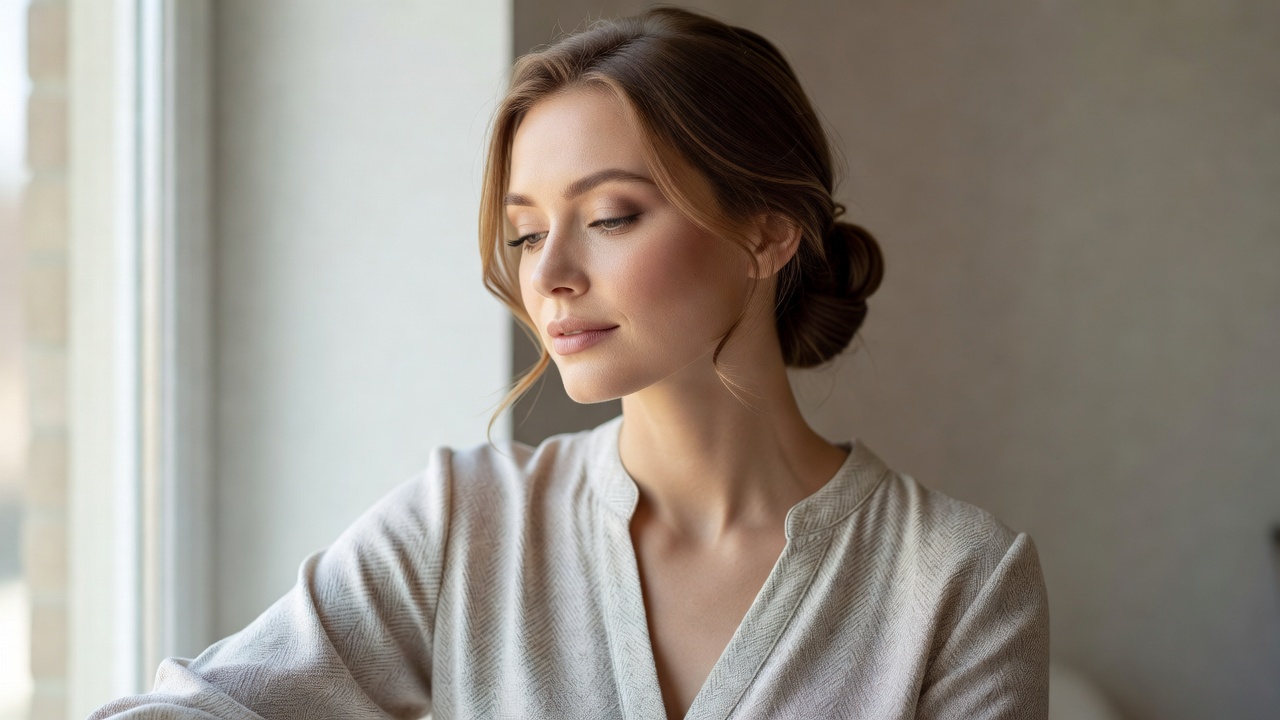
Screen beauty is not always designed to look beautiful. It may establish fatigue, ceremony, weather, age, habit or a character’s relationship with self-presentation. A carefully maintained face can belong to a disordered life; an apparently bare face can require substantial professional work. The visible result should not be confused with the amount of labour that produced it.
Read the whole frame
Start with the connection between face and clothing. A high neckline changes how much skin appears around the face. A reflective collar introduces light near the jaw. A strong lip can echo a garment’s colour or create a deliberate interruption. These are relationships we can observe without claiming to know the exact products used.
Hair also alters silhouette. Width around the head can balance a narrow shoulder line; a close style can make a collar more prominent. The useful question is not whether one arrangement improves every face. It is how the arrangement participates in this particular character image. Beauty criticism is more informative when it describes choices instead of ranking natural features.
Period references need research, not shorthand
A thin brow, a waved hairstyle or a particular lip outline does not identify an entire decade by itself. Practices differed by place, community, age and resources. Studio portraits are evidence of a photographed ideal, not proof that everyone looked that way in ordinary life. Museum collections, dated photographs and contemporaneous publications can help broaden the reference beyond a familiar star image.
The work of Max Factor and the screen images of Marlene Dietrich and Grace Kelly are useful historical research prompts, but a modern recreation should not be treated as a transparent window into their routines. Verify a product or technique claim before repeating it. A frequently circulated quotation can remain unsubstantiated however often it appears beneath a photograph.
Continuity is part of the finish
Production beauty may need to preserve a particular degree of shine, a hair parting or a mark across many takes. The appropriate method depends on the scene, schedule, performers and working conditions. It is not accurate to assume every set uses the same products or that every close-up requires heavy coverage. Camera tests and professional judgement matter more than a universal “film makeup” recipe.
Lighting and capture also change what the audience sees. A lip finish can appear less reflective from one angle, and skin texture can read differently under different illumination. Editing and colour grading introduce further variables. A screenshot cannot reliably identify a foundation shade, prove a skincare result or reveal the exact amount of product on a face.
Bring a principle into daylight
For an everyday interpretation, choose one relationship: a softened eye with a crisp collar, a defined lip against relaxed tailoring, or an understated face with a textured outfit. Use products you already know suit you, and assess the complete look in the light where you will wear it. There is no requirement to reproduce a performer’s features, skin tone or hair texture.
Try the clothes before adding more makeup. A neckline or earring may already provide the emphasis you wanted. If the result feels too formal, change one element rather than dismantling everything. A less reflective finish, a looser hairstyle or a simpler accessory can shift the mood while preserving the original idea.
Keep professional effects out of casual experiments
Prosthetics, theatrical adhesives and specialised effects products are not necessary for ordinary screen-inspired styling. Follow product instructions and warnings, use cosmetics only for their intended areas, and do not share products that touch the eyes or lips. Stop using a product if irritation occurs. Seek qualified medical advice for persistent or significant reactions rather than trying to solve them through a beauty trend.
Contact lenses deserve particular caution: they are not simply another accessory to borrow from a character. Consult an appropriately qualified eye-care professional and follow applicable local requirements. This publication does not provide medical advice or instructions for special-effects application. Our interest is the visual connection between costume and beauty, not persuading readers to recreate a production process.
The most practical takeaway is coherence. Choose a level of contrast, texture and formality that works across face, hair and clothing, then leave room for your own comfort. A successful reference can be quiet enough that nobody identifies the film. You still get to keep the idea.
Further context: the Victoria and Albert Museum offers design-history resources; the U.S. Food and Drug Administration provides consumer information about cosmetics. Local rules and individual health needs may differ.